
A few days ago we brought you the Ultimate online advertising Ad Tech glossary. On this occasion, we bring you this Ultimate RTB and Programmatic Guide for beginners to focus on one sector of online advertising: Programmatic advertising, defined as the automated purchasing and placing of digital ads. The Programmatic sector evolves especially fast, heavily relying on tech developments such as AI in order to bring an optimized experience to all stakeholders. Programmatic advertising is preferred by many agencies and Advertisers due to its increased efficiency, reach, and scalability. While this automated form of RTB Programmatic media buying and selling continues to evolve, it also introduces new terminology to the marketing world. Continue reading our Ultimate RTB and Programmatic Guide for beginners to find out, through the ELI5 methodology, how does Programmatic advertising work?
Ultimate RTB and Programmatic Guide for beginners
On this first section of the Ultimate RTB and Programmatic Guide for beginners we will address how Programmatic actually works, through the ELI5 (explain it like I am 5) method, giving you a basic explanation of RTB and ORTB in an easy and accessible way. The Programmatic industry is crowded with overcomplicated professional terms and jargon, yet the process that takes place during Programmatic advertising can be put in very simple terms, using ELI5 to explain “How does Programmatic advertising work?”: Every time that ad space is purchased, there are two sides, Advertisers (buyers) and Publishers (sellers). Each side relies on an online Advertising platform to make the transaction easier through the ad exchange.
This Ultimate RTB and Programmatic Guide for beginners has been built to help you come to terms with the most important and common acronyms and terminology used by Advertisers and Publishers in order to help you master RTB Programmatic media buying. To start with, there are a few categories of Programmatic:
- Private Marketplace: Only accepts selected Advertisers, usually based on an invite or registration basis.
- Programmatic Guaranteed: What is Programmatic Guaranteed? Advertisers can reserve a guaranteed amount of traffic, and Publishers are guaranteed that their spots will be purchased.
- Preferred Deals: Advertisers get priority access to specific traffic at a negotiated price.
- Programmatic Direct: What is Programmatic direct? Allows Advertisers to buy reserved traffic directly from Publishers using Programmatic tech.
- RTB and ORTB: We will be answering the questions ‘what does RTB stand for in Programmatic buying’ and ‘What are RTB and ORTB in Programmatic’ below.
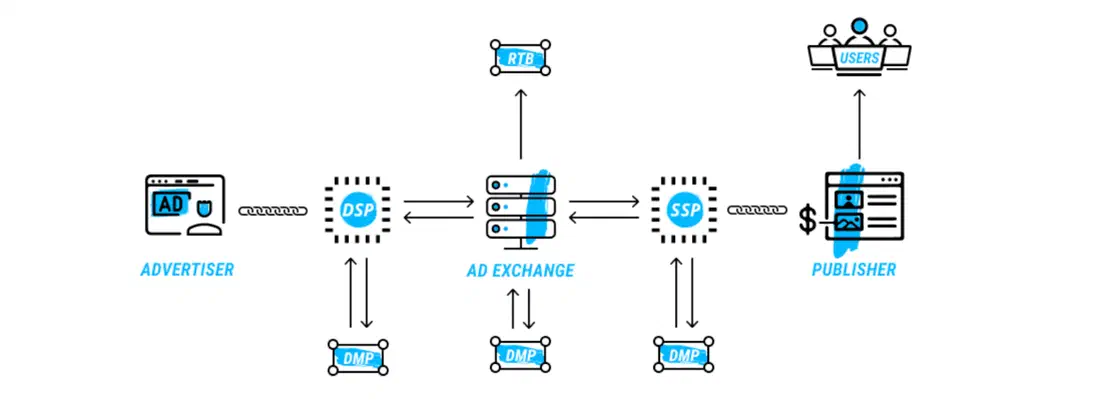
ELI5: How does programmatic advertising work? Basic explanation of RTB and ORTB
Let’s put the Programmatic process in simple terms to continue with the ELI5 methodology and complete this basic explanation of RTB and ORTB before diving into deeper waters. The process of the automated selling and buying of ad impressions happens in milliseconds:
- Publishers make their inventory available through SSPs (Supply Side Platforms)
- Advertisers create their campaigns and ads via DSPs (Demand Side Platforms). You will learn what is a DSP in programmatic below.
- Once an end user clicks on a Publisher site, the SSP will send ad requests to the DSPs and Ad Exchanges it is integrated with. We will be answering ‘What is an Ad Exchange in Programmatic?’ below.
- The Advertisers with ads that match the requirements of the ad inventory will start bidding for it.
- The winning ad gets to be displayed on the Publisher website.
- The data used to match Advertisers with ad inventory, comes from Data Management Platforms (DMPs).
Essentially, Programmatic advertising uses software to automatically match Advertisers that want to buy ad space with Publishers that have space to sell. Continuing on with ELI5: How does Programmatic advertising work, we will jump into the next section of EXADS’ Ultimate RTB and Programmatic Guide for beginners, where you will find basic Programmatic and RTB concepts:
ELI5: How does Programmatic Advertising work
Here you will find some more key basic concepts for our Ultimate RTB and Programmatic Guide for beginners, to complete our basic explanation of RTB and ORTB:
**Bid: **The amount that an Advertiser is willing to pay, based on a price model, to promote their offer.
Bid Request: A Real-time Bidding (RTB) request sent from an Ad Server to a buyer for the auction of a single impression.
Maximum Bid: The highest amount that an Advertiser is willing to pay for an ad zone.
Floor price: The minimum amount stated by a Publisher for which inventory can be sold.
**First Price Auction: **The winner of the auction for an impression pays the price they’ve offered.
Second Price Auction: The winner of the auction pays one cent more than the next highest bidder.
Video Ad-Serving Template (VAST): A template to structure tags and metadata transferred from an Ad Server to a video player. This enables Ad Servers to deliver the Video ad to a compatible player.
Continuing on in our Ultimate RTB and Programmatic Guide for beginners we will look into RTB (Real-time Bidding) and how ORTB simplifies integration with our partners:
Understanding RTB and Programmatic Media Buying strategies
We continue giving you a basic explanation of RTB and ORTB, on this occasion to aid you in your understanding of RTB and Programmatic Media Buying strategies. In this section of the Ultimate RTB and Programmatic Guide for beginners you will learn the difference between RTB Programmatic media buying and traditional media buying. The former is possible with just a set of tools and tech, while the latter requires human input in order to go through all the steps of the process, from initial contact to auction. Programmatic turns out to be a cheaper and faster method. Here you will also learn the main Programmatic Media Buying Strategies: RTB, ORTB and Header Bidding.
What is Header Bidding and why is it different to RTB
RTB: This concept is the very key to understand Programmatic in this Ultimate RTB and Programmatic Guide for beginners; Real-time Bidding or RTB is a process of buying and selling ad impressions through real-time auctions. This method can be used to buy or sell as little as a single impression, and scale for that number to be in the billions. The whole process, from initiating a bid request call in the user browser to the Advertiser bidding on the impression and returning the ad happens within milliseconds. The industry standard is between 100ms to 300ms, including both computation time and RTT (Round Trip Time). Its scalability, availability, and speed make it one of the top technologies used in modern-day advertising.
ORTB: Open Real-time Bidding (opens in a new tab) is a form of Real-time Bidding which aims to provide standards for communication between RTB parties, such as SSPs and Ad exchanges or Ad exchanges and DSPs. Following those recommendations, it helps prepare both parties on what to expect and consider it as a common language between two machines. Since the specification is quite vast and not every single feature may be fully supported by both sides, there are usually some modifications required, thus ORTB is not necessarily plug-and-play, but it aims to be.
Header Bidding: To help you in your understanding of RTB and Programmatic Media Buying strategies. it is key to answer the question “What is Header Bidding and why is it different to RTB?” Header Bidding in Programmatic advertising is a technical solution that allows Publishers to offer their impressions to multiple Ad Exchanges and demand partners at the same time, running an auction with all of them bidding against each other and making competition more fair. Put in simple terms, Header Bidding in Programmatic advertising is a different way of using RTB; the main difference is that when we think about RTB, we usually think of it as communication between servers, which is why it’s called S2S (Server to Server). Header Bidding in Programmatic advertising on the other hand, uses C2S (Client to Server), and it can completely kick out SSP: Client Side Header Bidding runs the auctions within the user’s browsers, while Server to Server uses an external server.
What are the key metrics of Programmatic advertising
In this section of our Ultimate RTB and Programmatic Guide for beginners you will learn what are the key metrics of Programmatic advertising, key to understand RTB and Programmatic Media Buying strategies:
Avg. Bid: Obviously, one of the very key metrics of Programmatic advertising, this is the average bid price for specific auctions.
**Avg. Time: **Average time between a request and response.
Errors: Number of bid requests that didn’t go through the bidding process due to errors.
Errors Ratio: Percentage of bid requests with errors against the total number of queries.
No Bid: Number of bid requests that did not return a bid.
No Bid Ratio: Percentage of requests that did not make it to the bid, against the total number of queries.
Queries: Number of bid requests sent to the Advertiser.
Resp. Ratio: Percentage of bid responses out of the total number of bid requests.
Skipped: Number of bid requests that were automatically throttled by the system.
Skipped Ratio: Percentage of Skipped requests against the total number of queries.
Success: The number of bid requests that were successful and received a response with no errors.
Timeouts: Number of bid requests that were timed out.
Timeouts Ratio: Percentage of requests that have timed out against the total number of queries.
Win Ratio: Percentage of wins against the total number of queries.
Wins: Number of bid requests that won the auction.
Now that we have learned what are the key metrics of Programmatic advertising, a key to understanding RTB and programmatic Media Buying Strategies, let’s jump into what is the IAB ORTB Api Specifications project.
Basic explanation of RTB and ORTB: What is the IAB ORTB Api Specifications project
A must-have in any Ultimate RTB and Programmatic Guide for beginners, let’s address what is the IAB ORTB Api Specifications project. In November 2010, the IAB developed the RTB Project (opens in a new tab), a document containing guidelines and protocols aiming to standarize RTB API specifications for Programmatic platforms. The mission of the OpenRTB project is to spur growth in Real-time Bidding (RTB) marketplaces by providing open industry standards for communication between buyers and sellers. There are several aspects to these standards including Real-time Bidding protocol, information taxonomies, offline configuration synchronization, etc.
What is the IAB ORTB Api Specifications project? Simply put, the aim of the project is to create a shared language which eases the communication between buyers and sellers, making integration easier, to enable faster and deeper innovation within each of the businesses. It is strongly encouraged for Programmatic platforms to follow these guidelines and protocols in order to provide a seamless service. EXADS’ Programmatic technology (opens in a new tab) relies on IAB’s ORTBv2.4 and ORTBv2.5 specifications.
Ultimate RTB and Programmatic Guide for beginners**: **What programmatic RTB platform should I use
“What Programmatic RTB platform should I use?” On this section of EXADS’ Ultimate RTB and Programmatic Guide for beginners, we talk about the most popular kinds of Programmatic RTB platforms to help you choose the best one to help you reach your advertising goals:
Ad Server: Ad Servers are the tech that stands behind ad platforms’ software such as Ad Networks, Publisher Ad Servers, Ad Exchanges, ensuring the proper functioning of the Ad Serving process; you can build your own Ad Network with EXADS’ Ad Server, fact that makes Ad Servers a key element when considering **"**What programmatic RTB platform should I use?" Ad Servers are also online platforms used to serve digital ads alongside content consumed by end users. With an Ad Server, Publishers can create ad zones on their platform and sell them to Advertisers.
Demand side platform, DSP:A Demand Side Platform is a Programmatic advertising platform that allows advertisers and RTB Programmatic media buying agencies to automate the buying of advertising inventory from different sources, and a basic concept to keep in mind in this Ultimate RTB and Programmatic Guide for beginners. This platform offers multiple benefits to Advertisers as an efficient way of creating, managing, monitoring and optimizing multiple Programmatic campaigns from one platform. The most obvious and immediate benefit is the wide reach of the ads.
**Supply side platform, SSP: **Publishers can serve Programmatic ads with the help of a supply side platform (SSP). The SSP is an essential part of RTB and it helps Publishers connect simultaneously to multiple Ad Exchanges, Ad Networks and DSPs. By offering their ad inventory to a multitude of demand sources, Publishers are guaranteed the best returns. DSPs also help protect their brand by ensuring that the displayed ads are relevant for their audiences.
What programmatic RTB platform should I use? More Programmatic platformsAd Exchange: What is an Ad Exchange in Programmatic? A Programmatic RTB Echange allow Publishers to make their ad inventory available to Advertisers through SSPs and from here, Advertisers, using DSPs, buy ad inventory via RTB. They are sometimes called digital marketplaces and they generally come under two forms:
- Open Ad Exchange: What is open Exchange in Programmatic? Allows all sellers and buyers access to the bidding process.
- Private Ad Exchange or Private Marketplace (PMP): Only allows selected buyers and sellers to bid for the ad inventory.
Data Management Platform, DMP: What is a DMP in Programmatic? DMPs role as Programmatic RTB platforms is to organize and segment the audience into different categories, using demographic information such as location, browsing behavior, devices, purchase history, etc. DMPs connect with Programmatic platforms like DSPs, SSPs and Ad Exchanges to facilitate accurately targeted advertising purchases. The data used by DMPs can come from various sources and can be:
- First Party Data: Collected directly from users by the company owning the platform (web analytics, CRMs, social media, subscriptions, etc.).
- Second Party Data: Collected from partners and associates.
- Third Party Data: Data from other platforms, used on top of first and second party data.
Asset Management Platform (AMP): Asset management platforms which helps Advertisers store, organize, share, and protect their digital assets. When Advertisers work on an ad campaign, there are plenty of assets they need to manage. Ad creatives, videos, documents, data, etc.
Consent Management Platform (CMP): Consent management platforms are used to promote safe Programmatic advertising. It helps Publishers collect and manage end user data while complying with policies like GDPR. CMPs also provide end users with a clear and concise way to understand how their data is being collected and used, allowing them to consent or withdraw.
We hope that we have helped you answer your question “What programmatic RTB platform should I use?”
Why should I use EXADS as my Programmatic platform
We hope that our Ultimate RTB and Programmatic Guide for beginners has been a useful read for you! We also hope that our ELI5: How does Programmatic advertising work tactic has cleared as many doubts as possible on “What do I need to know about RTB as a Publisher?” and in helping you better understanding RTB and Programmatic Media Buying Strategies. Do you have any more questions about RTB Programmatic media buying or want to learn more about EXADS’ RTB and Programmatic tools? Or maybe you are not wondering, “Why should I use EXADS as my Programmatic platform?”** Get in touch** with our team to find out or maybe you want to sign up now!