
Table of contents
- What is Conversion Tracking?
- What is The Bidder?
- Rules to Block Ad Zones
- How Conversion Tracking is used by advertisers
- Conversion Tracking tools
- Types of Conversion Tracking
- How EXADS Conversion Tracking feature works
- How do Profit and ROI metrics give insights into each goal?
- Use Case 1: E-commerce Store - Selling T-Shirts
- Use Case 2: Lead Generation - Software Company
- Use Case 3: Affiliate Marketing - Promoting a Travel Package
- Use Case 4: Mobile App Install Campaign
- Benefits to advertisers
- Benefits to ad networks and publishers
- Conclusion
Using EXADS as your white-label ad server comes with a host of free automation and optimization tools that your advertising clients can use. In today’s competitive market, tools that are integrated into an ad serving platform and are free to use, are of prime importance to your advertising clients. It can make the difference between them choosing to spend their budgets with your ad server or that of a competitor. Luckily EXADS provides some of the best ad server features for advertisers, to ensure that your ad serving business is competitive and to help you attract more and more advertising clients. In this blog post we will look at two free advertiser features provided with our self-service ad serving platform: The Bidder and Conversion Tracking. Both are very powerful tools independently, but using a combination of the two will give your advertising clients control over their campaign bidding automation and real-time campaign tracking for optimization. Let’s dive in!
What is Conversion Tracking?
Conversion tracking is the process in which an advertiser who has launched an ad campaign on an ad serving network, can see how an end user has interacted with the campaign. This is done by measuring the effect of specific data points during the ad campaign’s sales funnel and then analyzing the data that has been generated to understand what specific data points are reached via users they acquire. So for example, data points can be: when an end user clicks on an ad, the end user’s actions on a landing page, if they subscribed to a newsletter, if they signed up to an offer, if they made a purchase or downloaded a product. Each data point is called a Goal and advertisers can track several goals at the same time with our Conversion Tracking tool.
What is The Bidder?
Bidding for ad zones is the most important step for an advertiser to give visibility for their ad campaign. If the advertiser’s bid is too low, they will not win the ad zone, if the bid is too high, they will win the ad zone, but will be paying more for it than maybe their budget and KPIs allow. Constant manual optimization of bids is time consuming for advertisers, so an automation tool is an excellent add-on to offer to your advertiser clients. Step in EXADS advertiser feature, The Bidder! It works like a smart assistant automatically optimizing the advertiser’s bidding process in order to win ad zones at a competitive price based on the advertisers CPA and it then blocks ad zones that underperform for the advertiser’s campaign. The Bidder has two editable features: Automatic Bidding Optimization and Rules to Block Ad Zones.
Automatic Bidding Optimization: This intelligently adjusts the bids for ad zones according to how many conversions are received, and blocks those zones that don’t convert. This is done by the advertiser selecting a conversion goal from the Conversion Tracking drop-down. Based on the conversion goal’s conversion value, advertisers can choose between the following two methods:
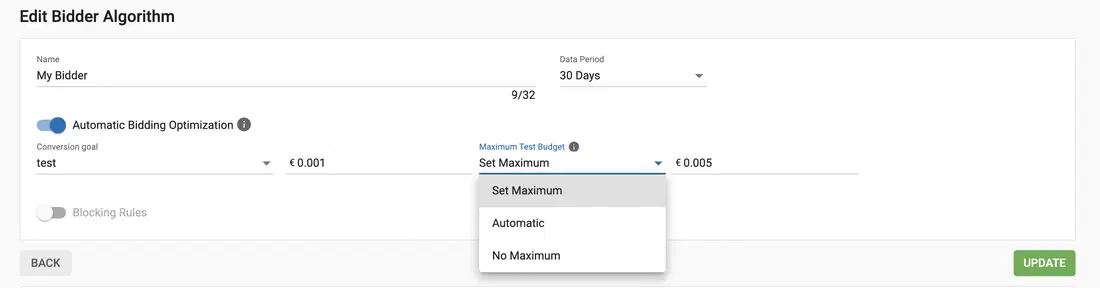
The Bidder will need information to work with, so it needs to run the campaign for a time before optimization begins. Therefore, you need to set the Maximum Test Budget you are willing to spend before the optimization starts.
The Maximum Test Budget can be:
- Set Maximum: The Advertiser can set their own Maximum Test Budget. The highest Maximum Test Budget you can set is 20 times the target conversion value.
- Automatic: By default, the Maximum Test Budget will be set at 5 times the target conversion value that is set.
- No Maximum: The Advertiser will have no limitation on Maximum Test Budget.
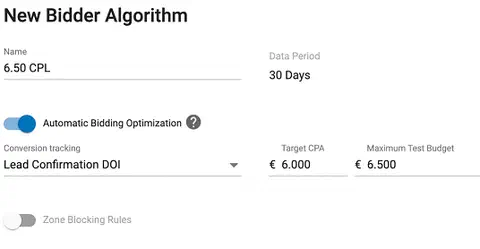
The payout for this advertiser’s DOI (Double Opt In) offer is €6.50, so the Bidder is set with the Target CPA at €6, which is 50 cents below the “real” CPA target and the maximum test budget aligned with the real CPA target. This strategy is aggressive and will help the advertiser to minimize any loss.
Rules to Block Ad Zones
This is the second feature within The Bidder. It allows advertisers to create additional optimization rules that determine what gets blocked automatically based on the rules set. On the left the Rules can be set based on Impressions, Clicks, Spending, CTR (Click Thru Rate), Conversions, eCPA, or ROI (Return On Investment). These elements can be combined to define which dimensions (selected from the drop down menu on the right) the rules will block.
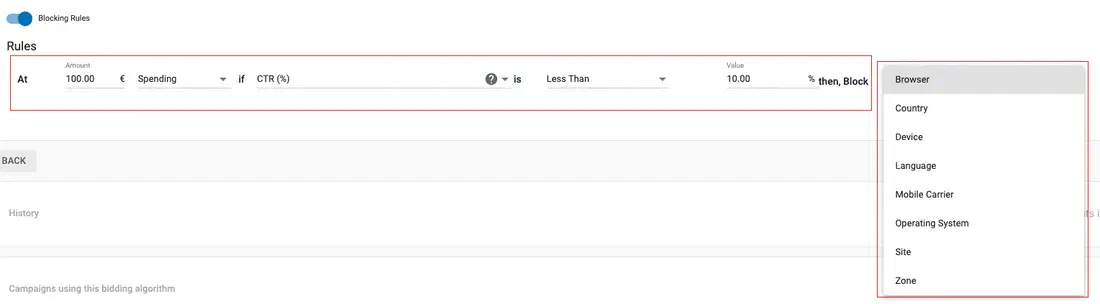
This is highly beneficial to your advertiser clients allowing them to automatically optimize their campaign targeting set up, based on their Target CPA and Maximum Budget settings. So for example, the advertiser could find that targeting Chrome is more expensive than Safari, therefore if the campaign is underperforming on Chrome, it will be blocked, ensuring the advertiser is not bidding too high for low quality traffic on Chrome. So the rule setting as shown above is: at 10,000 impressions, if the CTR is Less Than 10% then block Browser. You can read EXADS Documentation regarding The Bidder here (opens in a new tab). So, now let’s look at the second advertiser feature, Conversion Tracking.
How Conversion Tracking is used by advertisers
Because Conversion Tracking tools gather this data, it can be considered Business Intelligence for the advertiser. By analyzing the data points, the advertiser can see how the campaign is performing, how the ad creatives and landing pages are performing, how the campaign can be modified and optimized in order to help increase ROI. Perhaps an ad creative is generating many clicks, but once the end user reaches the landing page they are not converting, therefore the Conversion Tracking data alerts the advertiser that something needs to be modified on the landing page to push the end user to convert. These campaign insights are imperative because they help the advertiser fine tune the campaign creatives, bidding strategy, targeting and campaign flow in order to become successful.
Conversion Tracking tools
There are many third party real time tracking tools on the market that advertisers and affiliates use, popular names include Voluum (opens in a new tab), Cake (opens in a new tab), Thrive Tracker (opens in a new tab), AdsBridge (opens in a new tab) and more. Your advertiser clients can easily integrate all third party tracking tools into their campaign monitoring with your network if you use EXADS self-service ad serving platform. However, all of these third-party tools are not free, and advertisers have to pay subscription fees to use them. For example Voluum’s prices start at $499 to $1999 per month depending on the plan used. EXADS Conversion Tracking tool is completely free for your advertiser clients to use, meaning that they are saving money which they could then use to fund ad campaigns on your ad serving platform.
Types of Conversion Tracking
EXADS offers two types of Conversion Tracking:
- S2S(server to server) conversion tracking API: With this method, the Advertiser should add a {conversions_tracking} token to their landing page. When an end user clicks on the advertisement, this will generate a conversion tracking token with a unique ID. The advertiser then needs to record this unique ID to pass back on the conversion tracking API call when the goal is triggered.
- Pixel Tracking: This method will generate an HTML code that the advertiser can add into a webpage where the end user has visited immediately after completing the conversion (such as an “Order Confirmation” or “Thanks for Your Email” page).
EXADS Documentation offers a detailed description of how an advertiser can set up Conversion Tracking (opens in a new tab) for both S2S and Pixel tracking.
How EXADS Conversion Tracking feature works
The Conversion Tracking feature enables advertisers to choose a Conversion Value while creating or editing a conversion goal and then monitoring conversions through a detailed report on each of the conversions within the admin panel’s Statistics, Dashboard and Campaigns List Pages. Some of the key benefits are:
- Track each of the conversions with an accurate monetary value (Revenue).
- Obtain a more detailed report through the metrics: Conversion Rate, Profit, Revenue, ROI.
- The Profit and ROI metrics will give a good insight about each conversion goal.
- Based on these metrics, advertisers can adjust any conversion goals that are underperforming.
Advertisers can then add metrics in both Statistics, Dashboard and Campaigns List Pages under the Goals section to provide critical information about the conversions set by the advertiser.
The available metrics are:
- Cnvs (Conversions): Number of conversions that take place.
- CR (Conversion Rate): Records the percentage of users who have completed a desired action. This is calculated as Conversions / Clicks and then expressed as a %.
- CV (Conversion Value): A monetary value of the conversion, and it is used to determine the Revenue, Profit and ROI (Return on Investment) of the campaign. Conversions values are based on the following options as set by the Advertiser on Conversion Goal setup.
- No Value: The goal was setup with no conversion value.
- Fixed: The goal will have a fixed value each time it’s fired.
- Dynamic: A dynamic amount that was associated with the goal. This value is an average of all the conversions that have happened (Revenue/Conversions).
- eCPA: effective Cost Per Acquisition.
- Revenue: A monetary income that the Advertiser earns from the number of conversions that take place.
- Profit: Determines the amount by which the Advertiser is profitable based on the revenue and cost metrics.
- ROI (Return on Investment): A ratio between net income and investment.
To help quickly identify negative and positive trends, EXADS Conversion Tracking feature shows Profit and ROI data in 3 different colors:
- GREEN: ROI is more than 0%. The return on investment was positive and the advertiser was paying less for each conversion.
- BLACK: ROI is equal to 0%. The return on investment was break even. So the advertiser could check the detailed statistics of the campaign to improve some sources of traffic.
- RED: ROI is less than 0%. The return on investment was negative and the advertiser was paying more for each conversion than he could afford. The advertiser could check the sources of traffic and if the campaign setup had errors that needed fixing.
How do Profit and ROI metrics give insights into each goal?
Below are some use case examples demonstrating how EXADS conversion tracking metrics can be used in real-world scenarios:
Use Case 1: E-commerce Store - Selling T-Shirts
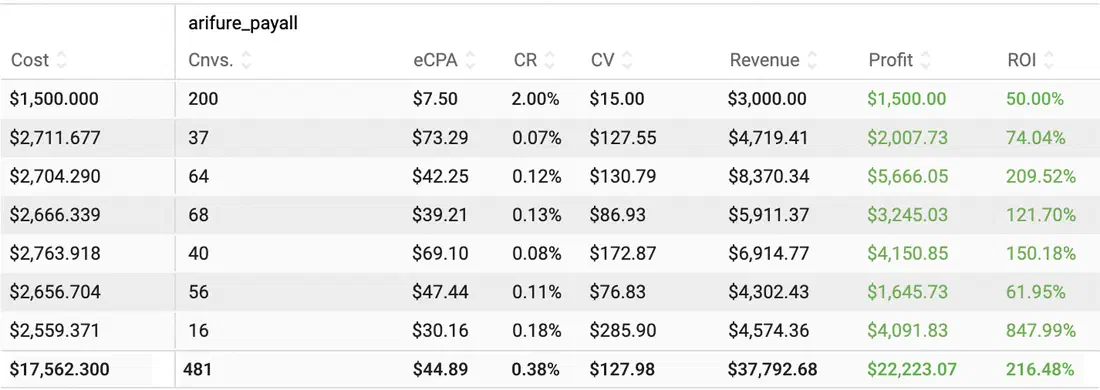
- Scenario: An online store sells t-shirts. They are running a campaign promoting a new line of graphic tees. They set up conversion tracking with a Fixed value of €15 per conversion (the average profit per t-shirt sale).
- Metrics Used & Analysis:
- Conversion Rate: After a week, the conversion rate is 2%. This means 2 out of every 100 clicks on the ad resulted in a t-shirt purchase.
- Revenue: The report shows €3,000 in revenue from this campaign.
- Profit: The report shows a profit of €1,500. This indicates the campaign is generating more revenue than the advertising spend.
- ROI: The ROI is 50% (Green). This signifies a positive return on investment, meaning the campaign is profitable.
- Action Taken: Because the ROI is positive and high, the advertiser decides to increase the budget for the campaign to reach a wider audience. They also analyze the traffic sources that are driving the highest conversion rates and focus their budget on those sources.
Use Case 2: Lead Generation - Software Company
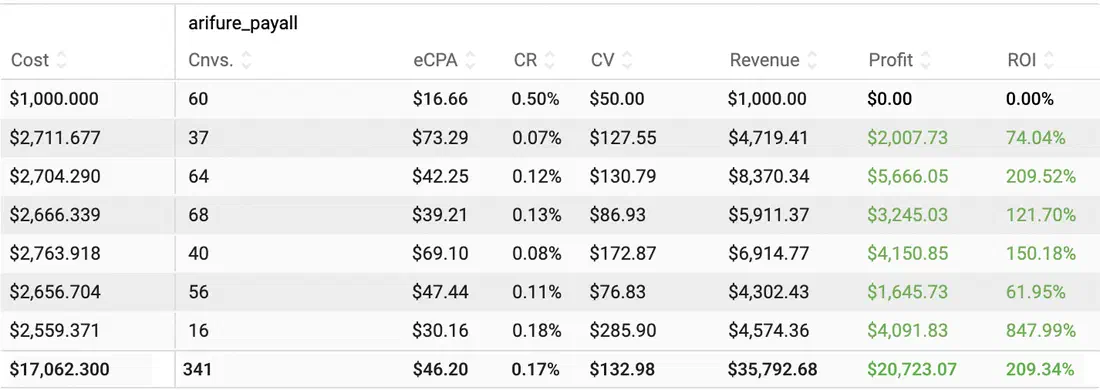
- Scenario: A software company is running a campaign to generate leads for their new CRM software. They set up conversion tracking with a Fixed value of €50 per lead (estimated value of a qualified lead).
- Metrics Used & Analysis:
- Conversion Rate: The conversion rate is 0.5%. This is lower than expected, meaning only 0.5% of clicks are resulting in leads.
- Revenue: The report shows €1,000 in revenue from the leads generated.
- Profit: The report shows a profit of €0. The ROI is 0% (Black).
- ROI: 0% (Black) indicates the campaign is breaking even.
- Action Taken: The advertiser analyzes the campaign and discovers that the landing page has a high bounce rate. They decide to redesign the landing page to make it more engaging and improve the call to action. They also A/B test different ad creatives to see which ones perform better.
Use Case 3: Affiliate Marketing - Promoting a Travel Package
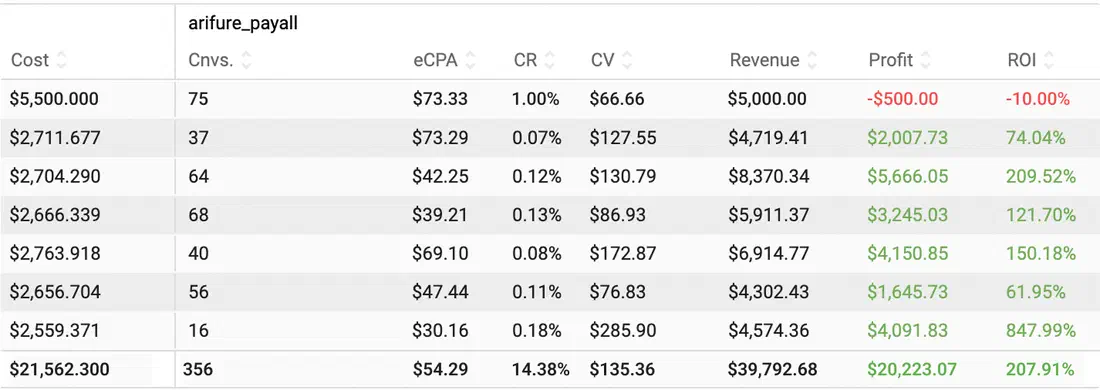
- Scenario: An affiliate marketer is promoting a travel package. They set up conversion tracking with a Dynamic value. The value of each conversion depends on the package purchased, which is automatically passed to EXADS via a parameter in the conversion tracking pixel.
- Metrics Used & Analysis:
- Conversion Rate: The conversion rate is 1%.
- Revenue: The report shows €5,000 in revenue. This reflects the total value of the travel packages sold through their affiliate link.
- Profit: The report shows a profit of -€500.
- ROI: -10% (Red) indicates a negative ROI.
- Action Taken: The advertiser investigates why the campaign is losing money. They discover that their click-through rate is low and their cost per click is too high. They decide to try different targeting options to reach a more qualified audience and negotiate a better rate with the ad network. They also look at which specific travel packages are being purchased and optimize their campaign to promote the higher-value packages.
Use Case 4: Mobile App Install Campaign
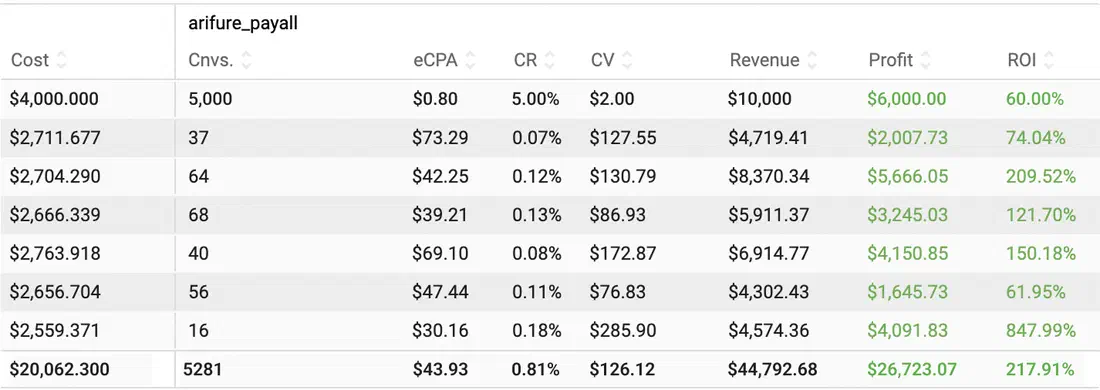
- Scenario: A mobile game developer runs a campaign to drive app installs. They use a Fixed conversion value of €2 per install (based on the estimated lifetime value of a user).
- Metrics Used & Analysis:
- Conversion Rate: 5%
- Revenue: €10,000
- Profit: €6,000
- ROI: 60% (Green)
- Action Taken: The high ROI allows the developer to scale the campaign. They increase their daily budget, expand their targeting to new demographics, and explore new ad formats to further boost installs. They also start A/B testing different in-app onboarding flows to maximize user retention and in-app purchases, which will further increase their ROI.
These examples illustrate how the different conversion tracking options and metrics can be used to gain valuable insights into campaign performance and make data-driven decisions to optimize advertising spend and maximize ROI. The color-coded ROI provides a quick visual cue, allowing advertisers to rapidly identify areas needing attention and celebrate successes.
Benefits to advertisers
Both of these features work hand in hand to give advertisers full control of their campaign. Summing up, here is a list of benefits for advertisers:
- Cost saving: These industry leading tools are free to use, so saved costs can be reinvested into campaigns.
- Ad spend budget control: The Bidder helps advertisers win the best converting traffic sources at a competitive bid price, limiting over spending and budget burn out on non-converting ad zones.
- Campaign testing: Automatic optimization allows for the testing of a large range of ad zones, without commiting to a large test budget to see what is working and what isn’t.
- Real time control: The campaign statistics give advertisers real time analysis throughout the evolution of campaigns.
- Quick identification: Because the Conversion Tracking feature uses the colors red, green and black, advertisers can easily see what is making a profit and what needs to be optimized or paused in real time.
- Many data points: With a large range of Goals, Dimensions and Data points available for rule setting, this allows for deeper automated campaign optimization and tracking to fine tune the sales funnel.
- Full flexibility: Advertisers can use The Bidder with EXADS Conversion Tracking feature or with their preferred third-party conversion tracking tool.
Benefits to ad networks and publishers
- Industry leading features: The Bidder used in partnership with EXADS Conversion Tracking feature allows advertisers free access to industry leading campaign optimization.
- Keeps you competitive: For ad networks and publishers, your advertiser clients know that your ad serving platform has these features that they can use to help them keep their ROI optimized. This is key, because if advertisers end up burning money testing your network’s ad zones, they are unlikely to test future campaigns on your network. This will stifle your advertiser client growth, and you need those advertisers to compete with each other to keep your publisher network happy, knowing that they can generate good revenues for their traffic with your network.
- Increases client spend: By automating the advertiser’s bidding optimization, they are able to build up white lists of ad zones that convert for them on your network. Allowing advertisers to increase their spend for their campaign and also allowing them to test that white list with other campaigns to further increase their spend with you.
- Build strong client relationships: The features help you build strong relationships with your advertiser clients. They allow them to scale up their campaigns with your network, because they don’t have to manually adjust each bid. This frees up more of the advertiser’s time to set up more campaigns on your network.
- Helps you grow your offering: The Bidder and Conversion Tracking features are great tools to promote to potential new clients to help you win more business and grow your advertiser base.
Conclusion
You can read an advertising campaign case study here where we demonstrate how EXADS advertiser features The Bidder and Conversion Tracking work together to help optimize a campaign. In conclusion, by using EXADS white-label ad server as a network, publisher, or as an advertiser, you have a rich list of features that are available to you without additional costs. Powerful tools such as The Bidder and Conversion Tracking will help to save time and increase your ROI. Find out what other powerful features we offer by getting in touch today!