API based ad server vs. Hosted ad server: Choosing the right solution for ad operations

Choosing the right ad serving infrastructure can define how efficiently your campaigns are managed, measured, and scaled. Two common options lead the discussion: API based ad servers and hosted ad servers. While both serve ads and manage campaigns, they differ in flexibility, control, scalability, and technical complexity. Here’s how they compare—and how to decide which fits your business best.
What is a Hosted Ad Server?
A hosted ad server (or managed/SaaS ad server) is a third-party platform that handles all the backend infrastructure, updates, and maintenance. Users log into a dashboard to upload creatives, set targeting, manage campaigns, and track performance.
Key Features
- User-friendly interface: Manage everything via a web dashboard.
- No coding required: Great for teams without developers.
- Automatic updates: The vendor handles uptime and performance.
- Built-in tools: Reporting, targeting, and analytics included.
Advantages
- Easy to use: Quick setup and campaign management.
- Low maintenance: Vendor takes care of hosting and security.
- Predictable pricing: Typically subscription or usage-based.
- Reliable performance: Professionally managed infrastructure.
Drawbacks
- Limited customization: You’re bound by the platform’s features.
- Data ownership concerns: Data usually stays on the vendor’s servers.
- Integration limits: Harder to connect with internal systems.
- Vendor dependency: Pricing or policy changes are out of your control.
Hosted ad servers are best for small to mid-sized advertisers and publishers who want simplicity and reliability without heavy technical investment.
What is an API Based Ad Server?
An API based ad server provides programmatic access to ad serving functions via structured endpoints. Instead of relying on a visual dashboard, developers use the API to integrate ad serving directly into their own systems or platforms. This gives businesses full control over how ads are delivered, how data is managed, and how workflows are automated.
Key Features
- Programmatic control: Manage campaigns, creatives, targeting, and reports through code.
- Custom integration: Connect easily with CRMs, analytics, or internal tools.
- Data ownership: Store and process data your way.
- Automation: Streamline setup, reporting, and optimization.
Advantages
- Total customization: Tailor workflows and interfaces to your needs.
- Data transparency: Direct access to raw performance data.
- Deep integration: Sync seamlessly with existing systems.
- Scalability and automation: Build flexible, growth-ready operations.
Drawbacks
- Technical complexity: Requires developer expertise.
- Longer setup time: Building and testing integrations can take weeks.
- Ongoing maintenance: Responsibility for hosting and uptime.
- Higher upfront costs: Development requires initial investment.
API based ad servers are ideal for large publishers, ad networks, and tech-focused organizations seeking flexibility, automation, and control.
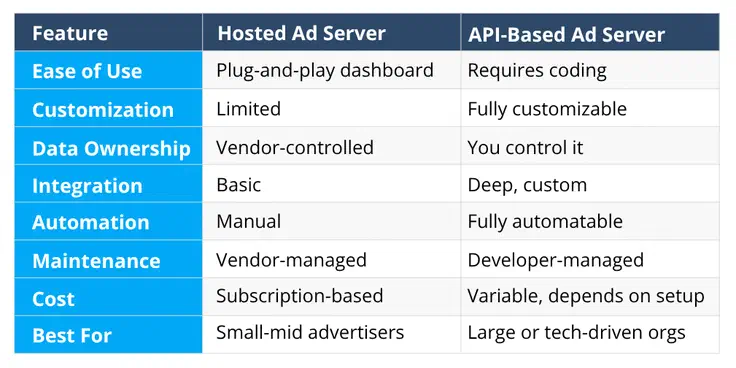
Key Differences
When to choose a Hosted Ad Server
Choose a hosted ad server when your goal is simplicity and speed. It’s best for teams that:
- Want a ready-to-use system with minimal setup.
- Lack in-house development resources.
- Are fine using built-in reporting and dashboards.
- Prefer predictable pricing and vendor maintenance.
Hosted solutions let marketers focus on campaign performance rather than technical operations.
When to choose an API Based Ad Server
Go with an API based ad server if you need control, scalability, and customization. It’s ideal if you:
- Want to integrate ad serving into your product or platform.
- Need automation or real-time optimization.
- Value complete data ownership and transparency.
- Have the technical capacity for development and maintenance.
For example, an ad network can use an API based server to unify demand sources, automate campaign updates, and feed real-time data into custom analytics.
Hybrid ad serving solutions: Best of both worlds
Some modern ad servers now offer hybrid options—a hosted platform with full API access. This setup gives marketers a dashboard for everyday management and developers an API for automation and integration. It’s a flexible approach that balances ease of use with technical freedom, appealing to both marketing and engineering teams.
Conclusion: Which is right for you?
Your choice depends on your goals, technical resources, and scale:
- Choose a hosted ad server for simplicity, low maintenance, and quick deployment.
- Choose an API based ad server for flexibility, control, and automation potential.
- Consider a hybrid solution if you need both ease of use and customization.
In a data-driven ad ecosystem, your ad server is more than just a delivery tool—it’s the foundation of your monetization and optimization strategy. Whether you prioritize simplicity or innovation, choosing the right model ensures your campaigns run efficiently, your data remains accessible, and your business scales seamlessly. EXADS offers full flexibility to meet all your ad serving needs, get in touch with us to find out more!